
Effort Is Not the Enemy
There’s a difference between being tired and being drained.

I thought burnout was about doing too much. Working 80-hour weeks. Saying yes to everything. The usual suspects.
But mine came from doing too little of what mattered.
When I stepped into a full product leader role, I made my focus structuring the org and setting up the team. I thought that's what "senior" meant - less tinkering, more managing. Less hands-on work, more administration.
I let go of the vision and tactical aspects of product that I actually enjoyed. No more building things. No more direct problem-solving. I became an administrator of other people's work instead of a creator of my own.
I looked productive from the outside. My calendar was full of one-on-ones and planning sessions. I was "leading" - or at least performing what I thought leadership looked like.
But every night, I felt drained. Not tired, drained. Like someone had siphoned my energy for nothing in return.
I'd spent between eight to twelve hours "working" but couldn't point to a single thing I'd actually built or figured out. I was motion without progress. Activity without achievement.
That's when I realized: effort isn't the enemy. Misaligned effort is.
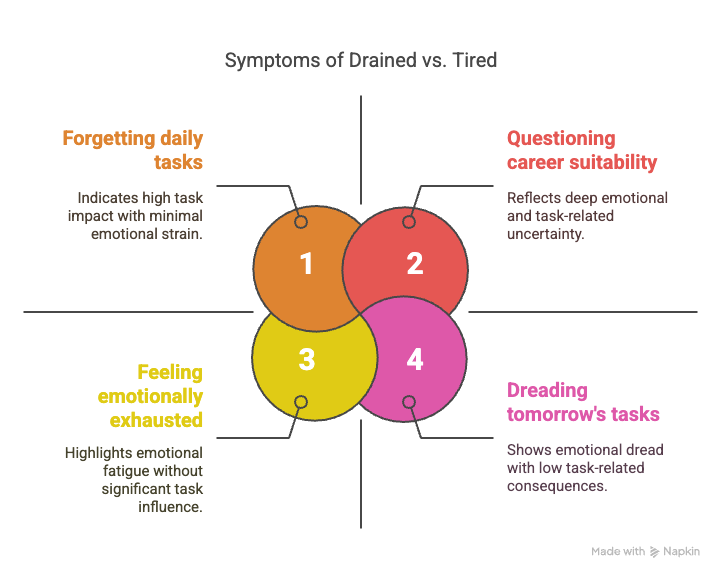
The Tired vs. Drained Test
There's a difference between being tired from aligned effort and being drained by pointless motion.
Tired says: "I worked on something that mattered." Drained says: "I was busy but can't remember why."
You know you're tired (the good kind) when:
You can explain what you built or learned today
You feel closer to solving a real problem
You're mentally exhausted but oddly satisfied
You go to bed thinking about tomorrow's progress
You gained confidence in your ability to handle difficulty
You know you're drained when:
You were busy all day but can't remember what you accomplished
You feel further from anything that matters
You're emotionally exhausted and frustrated
You dread doing the same thing tomorrow
You question whether you're cut out for this work
I learned this difference the hard way through my personal time. I started shifting my personal routines super early in the day to make sure I was present for the moments that mattered to me. Long days, but energizing days because I was aligned with the person I was becoming.
The moment I started trying to please people more, sacrificing my own personal buffer zones, I felt robbed of my own time. Less hours, a lighter day but a completely different energy.
The work itself isn't what matters. It's whether the work compounds or just consumes.
The Identity Question
Here's what we miss about effort: it builds identity.
You become what you repeatedly do. When your effort aligns with what matters to you, each day of hard work makes you more confident in your ability to go deep.
And you know you can go full monk mode whenever necessary.
You know how hard you can push, so you can modulate your efforts accordingly. The parallels are infinite: think of the ultra runner, the bodybuilder, the cyclist engaging in Tour de France. They all know how hard they can push and they know why they do it.
You don’t build confidence by thinking about your goals.
You build it by doing hard things that align with them.
Effort isn’t just a means to success.
It’s the process of becoming someone you trust.
Every time you show up with intention, even when it’s boring, frustrating, or scary, you cast a vote for the kind of person you want to become.
It’s not sexy.
It doesn’t always look like “balance.”
But it builds something real.
And that’s where so much burnout comes from today:
We’re putting in effort.
But it’s not ours.
When I was focused on org structure and team management, I became someone who administered other people's creativity instead of exercising my own. When I was optimizing processes, I became someone who talked about work instead of doing it.
None of these versions of me felt real. They felt like costumes I was wearing to look the part of what I thought a "senior" person should be.
But when I started protecting time for the tactical work I actually enjoyed, the vision, the building, the problem-solving, I became someone who could see patterns others missed. When I put effort into understanding problems deeply instead of managing them from a distance, I became someone who could create value from nothing.
The compound effect isn't just about output. It's about identity.
The seductive lie is that impact should feel easy. That if you're struggling, you're doing it wrong. That seniority means less hands-on difficulty, not more meaningful difficulty.
But the opposite is true. Impact doesn't wait for a job description. It doesn't wait for the perfect tool or the right title.
Impact starts with your willingness to engage with meaningful difficulty.
The AI Parallel: Browsing vs. Building
This plays out in how people approach AI right now.
I've watched myself fall into the same trap on a smaller scale. Spending time browsing and quick-testing different tools for the same results, instead of focusing on solving specific problems or questions I actually had.
Most people are experiencing "AI fatigue", not because AI is hard, but because they're consuming it instead of applying it.
They're subscribing to AI newsletters, watching YouTube tutorials, and collecting prompts. They're learning about AI instead of learning with AI.
But learning to use AI effectively is like learning to ride a bike. You can read every manual ever written, but until you get on the bike and fall down a few times, you haven't learned anything.
The people who are actually benefiting from AI aren't the ones with the most tools. They're the ones who picked one tool and used it to solve one real problem until they understood how it thinks.
They didn't start with "What can AI do?" They started with "What problem do I need to solve?" Then they used AI to solve it.
Same effort. Completely different results.
The Substack Trap: Writing vs. Performing
This same pattern is playing out in the creator economy, and I'm watching it happen in real time.
I'm new to Substack, but I'm already observing people chasing virality for the sake of it. The pressure to grow subscribers is turning writers into performers instead of thinkers.
It's hard to tell the difference between genuine content creation and quick hacks to build engagement. The line between writing to capture your thoughts and writing to capture an audience gets blurrier every day.
I see writers seeking recognition and validation through metrics instead of clarity through writing. If your newsletter is your income, I understand the pressure for engagement tactics. But I'm more worried about people following the same blueprint when they actually write to capture their thoughts.
The difference is clear when you see it:
Writing as a thinker:
Explores ideas without predetermined conclusions
Uses personal experience as data, not authority
Questions assumptions instead of reinforcing them
Values clarity over cleverness
Admits uncertainty and evolving perspectives
Writing as a "successful Substack writer":
Leans heavily on listicles and frameworks
Claims authority on subjects for credibility
Reinforces popular opinions for agreement
Optimizes for shares over understanding
Performs confidence even when exploring new territory
The successful writer formula feels hollow because it optimizes for engagement over insight. It's the same misaligned effort, just in a different context.
Writers are becoming caricatures of thought leaders instead of actual thinkers. They're chasing subscriber counts instead of interesting questions. They're performing expertise instead of developing it.
But don’t get me wrong, I see a ton of successful writers that are both. Genuine thinkers, sharing real value, helping people grow and growing themselves.
I see an amazing community where people engage, share thoughts and learn in public, together.
Just when I was thinking about this article, I was amazed at how relatable that subject is. Everyone has gone or have watched someone going through losing their purpose. And there are a ton of shared experiences to find. Like this one from Life Between the Systems

And it feels great seeing people finding their purpose with people like Wes Pearce or Moe_Ben.
We need more of these testimonials, to wake up people from empty pursuits, showing that a different path is possible and available.
What Happens Next
In a world running from hard things, your relationship with effort becomes your competitive advantage.
While everyone else is looking for shortcuts, you're building the muscle to go deep on things that matter.
While they're optimizing for ease, you're optimizing for alignment.
While they're performing productivity, you're creating value.
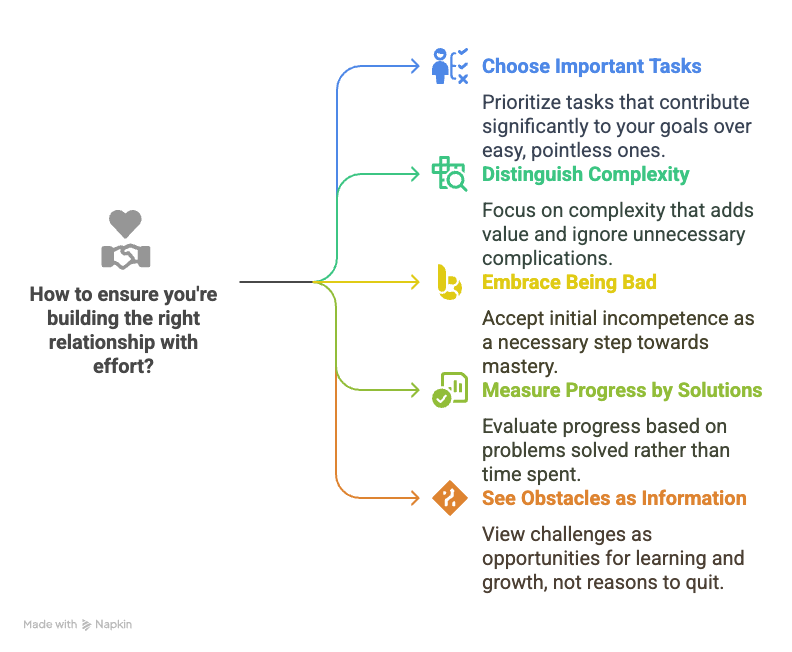
Signs you're building the right relationship with effort:
You choose the difficult but important task over the easy but pointless one
You can distinguish between complexity that matters and complexity that doesn't
You're comfortable being bad at something before you get good
You measure progress by problems solved, not hours worked
You see obstacles as information, not evidence you should quit
Signs you're trapped in effortless motion:
You're always looking for the next productivity hack or life-changing tool
You feel busy but can't point to meaningful progress
You avoid tasks that don't have clear, immediate outcomes
You measure productivity by activity, not results
You see difficulty as proof you're doing something wrong
The compound effect is real, but it's not just about skills. It's about identity.
Every day you choose aligned effort over easy motion, you become more of the person who can handle difficult, important work.
Every day you choose the shortcut, you become more dependent on shortcuts.
This matters more than you think. The problems worth solving are getting harder, not easier. The competitive landscape is getting more complex, not simpler. The pace of change is accelerating, not slowing down.
The people who thrive won't be the ones with the best tools or the smoothest processes. They'll be the ones comfortable with meaningful difficulty.
The question isn't whether you should work hard. The question is: are you working hard on things that build the person you want to become?
Because effort isn't the enemy. Effort without direction is.
The difference will determine whether you go to bed tired or drained. Whether you build confidence or anxiety. Whether you create something real or just stay busy.
Choose tired.
Your piece is fantastic! I love it. You give an actionable plan.
And this part:
"That's when I realized: effort isn't the enemy. Misaligned effort is"
This doesn't hit close to home — it started paying rent 😀
Thanks for the shout-out!! It means a lot.
Valentin,
Excellent article!
Feels like you took it directly from my own life.
I too have moved from a doer/maker role to management.
Such a challenge to have the same level of fulfilment.